
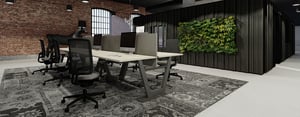
Typologies and standards
A defined set of settings — what a focus desk contains, what a collaboration table needs, what goes in a six-person room — documented so that the next order, the next floor and the next building match. Without standards, an estate accumulates variants until nothing is interchangeable and everything is a special order.

Ergonomics that hold up under use
Adjustability that people can actually operate, seating specified for the hours it will genuinely be sat in, and height-adjustable desks where the case is real rather than fashionable. Poor ergonomics does not present as a furniture complaint; it presents as absence.

Lifecycle rather than capital cost
A chair replaced at year four costs twice what one replaced at year twelve does, before disposal, disruption and a second procurement exercise. We specify against whole-life cost, with a 10-year supported warranty, continuity of parts agreed with the supply chain, and take-back at end of life.

Aligned to how you can actually buy
A specification that cannot be bought through your available route is a wasted document. We check the specification against the buying mechanism early — framework, tender or direct — so the standard and the route agree with each other.

Where this usually starts
Most often as the second half of a space planning or workplace strategy engagement. It works on its own where an organisation already knows what it wants and needs the standard written down.
Get in touch using the form below or keep browsing for more information
